How to start forex trading as a beginner in 2026 with a simple market structure strategy
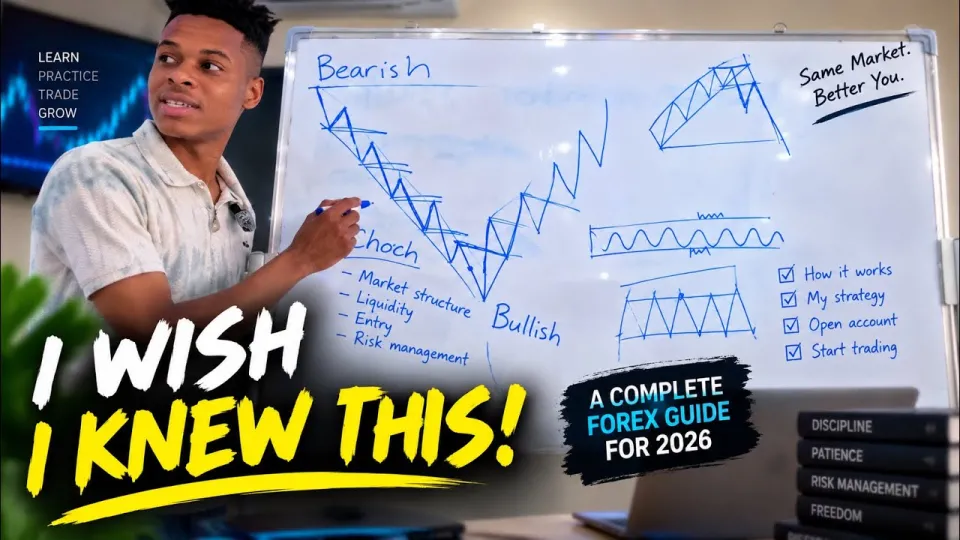
Video: How To Start Forex Trading For Beginners in 2026 (Full Guide + My Strategy)
You can order the same kind of articles for your own video to boost it on YouTube and Google. Just message the Telegram bot @sat_sit_bot. The bot writes and publishes the articles itself (with your YouTube video embedded) on popular topical websites (no ads). Your first 50 articles are free.
· based on the channel Carl Fx
Key takeaways
- Forex is an over-the-counter market where currencies trade in pairs 24 hours a day, five days a week, with no central exchange.
- Start on a demo account, define risk per trade in advance (often 1% or less of the account), and only move to real money after a consistent process.
- Market structure — higher highs and higher lows versus lower highs and lower lows — is the foundation for reading bullish and bearish conditions before any indicator.
- A simple strategy needs three parts: a bias from structure, a defined entry trigger and a fixed stop-loss and target.
- Most beginner losses come from oversized positions, no stop-loss and revenge trading after a loss, not from a lack of indicators.
Forex trading for beginners in 2026 starts with three steps: learn how currency pairs are quoted and traded, open a demo account with a regulated broker, and practise reading market structure before risking real money. The market itself is simple to access, but the skill that decides the outcome is risk control and repetition, not a secret indicator. This guide follows the beginner roadmap laid out by Carl Fx in his full walkthrough, and you can open a live or demo account through TFC Global Markets registration when you are ready to place your first trades.
What forex trading actually is and how the market is structured
Forex is the exchange of one currency for another at an agreed price, and every trade is a bet on the relative strength of two economies. Currencies are always quoted in pairs, such as EUR/USD or GBP/JPY: the first currency is the base, the second is the quote, and the price tells you how many units of the quote currency buy one unit of the base. Unlike stocks, there is no central exchange — trading happens over the counter between banks, brokers and liquidity providers, which is why the market runs around the clock from Monday morning in Asia to Friday evening in New York.
Three practical details matter for a beginner:
- Sessions. Liquidity concentrates in the London and New York sessions; spreads are usually tightest then and widest during the late Asian session and around major news releases.
- Leverage. Brokers offer leverage that lets you control a large position with a small deposit. It multiplies both gains and losses, so the position size — not the leverage number — is what you actually control.
- Costs. Spread, commission and swap (the overnight financing charge) are the real cost of trading. A strategy that ignores costs can look profitable on paper and lose money live.
Major pairs like EUR/USD and USD/JPY have the tightest spreads and the most reliable price behaviour for a beginner; exotic pairs can move violently on thin liquidity.
How to open a trading account and get started from zero
Opening an account takes minutes, but the decisions around it take longer, and this is where most beginners rush. The sequence that works:
- Choose a broker with clear regulation and segregated client funds. Check who licenses the entity you are actually signing up with, not just the brand name.
- Register and verify your identity. Expect to upload an ID and a proof of address; verification is a legal requirement, not an obstacle.
- Open a demo account first. Trade the same pairs and the same strategy you intend to use live, for at least a few weeks or a few dozen trades.
- Fund with an amount you can afford to lose entirely. A small account is not a problem — an oversized one you cannot replace is.
- Set your risk per trade before your first order. A common starting point is 1% of the account or less, calculated from the stop-loss distance and lot size.
Carl Fx notes in the video that he owns the brokerage he recommends, which is a disclosure worth taking at face value: the account-opening link is a business relationship, so compare the terms with other regulated brokers before depositing.
Reading bullish and bearish markets through market structure
Market structure is the map of swing highs and swing lows, and it tells you which side of the market is currently in control. In a bullish market, price prints higher highs and higher lows; in a bearish market, it prints lower highs and lower lows. A trend continues until that pattern breaks — a bullish structure fails when price takes out the most recent higher low and closes below it.
Price action is read on the chart itself, without indicators: candles, wicks, consolidation and the way price reacts at previous levels. A beginner can build a usable bias in three steps:
- Mark the last two or three significant swing highs and lows on the higher timeframe, such as the 4-hour or daily chart.
- Label the current sequence: higher highs and higher lows means look for longs, lower highs and lower lows means look for shorts.
- Drop to a lower timeframe only to find an entry inside the direction the higher timeframe already gave you.
Trading against structure is the most common reason a technically correct setup still loses. If the daily chart is bearish, a bullish pattern on the 5-minute chart is a counter-trend trade, and it deserves either a smaller size or no trade at all.
A simple beginner strategy you can practise this week
The strategy Carl Fx builds the guide around is deliberately plain: define a bias from market structure, wait for a pullback, and enter on a confirmation trigger with a fixed stop. A workable version looks like this:
- Bias. On the 4-hour chart, confirm whether structure is bullish or bearish.
- Zone. Identify the area price is likely to return to — the last consolidation or the origin of the most recent impulse move.
- Trigger. Wait for price to reach the zone and show a rejection or a change of structure on a lower timeframe, such as the 15-minute chart.
- Risk. Place the stop-loss beyond the swing that invalidates the idea, then size the position so that the loss equals your fixed risk percentage.
- Target. Take profit at the next structural level, aiming for at least two times the risk so that a modest win rate still produces a positive result.
One strategy practised on one or two pairs beats five half-learned systems. Journal every trade with a screenshot, the reason for entry and the result; after 30 to 50 trades the pattern in your own data becomes obvious.
Common mistakes and the questions beginners keep asking
Most beginner accounts are lost to behaviour, not to analysis, and the same doubts come up again and again in the comments under beginner guides. The recurring ones:
- "I don't understand the charts yet." That is normal in week one. Reduce the number of concepts to structure, support and resistance, and one entry pattern, then study chart examples until the pattern is recognisable.
- "I can't open a real account." Verification failures are usually document problems — a blurry ID, a name mismatch or an address document that does not match the registration. Fix the paperwork before worrying about strategy.
- "I want to start this week and make it." Starting is fine; expecting income is the trap. Treat the first months as paid tuition on a demo or a very small live account.
- "I'm printing money on a small account." A profitable streak over a few trades is not evidence of an edge. Judge a strategy over dozens of trades and across different market conditions.
The mistakes that cost the most money:
- Trading without a stop-loss or moving it further away to avoid being wrong.
- Risking 10–20% per trade, so two losses wipe out the account.
- Revenge trading immediately after a loss.
- Overtrading during low-liquidity hours or around high-impact news.
- Following signals without understanding the reasoning, so nothing is learned when the signal fails.
Managing risk so a bad week does not end the account
Risk management is the part of forex trading that keeps you in the game long enough to become consistent. Decide the maximum you will lose per trade and per day before the session starts, and treat both as hard limits. If your account is $1,000 and your risk is 1%, each loss costs $10 — which means a stop-loss distance of 20 pips allows a 0.05 lot position, while a 50-pip stop allows roughly 0.02 lots.
Keep a simple rule set: no more than two or three losses in a day, no trading during major central-bank announcements unless that is part of the plan, and a weekly review of results. Drawdown is the number that matters — a 50% loss requires a 100% gain to recover, which is why protecting capital comes before chasing returns. Trading is not about getting rich overnight; it is about learning, discipline and improving a little each week.
Useful links
- Open an account with TFC Global Markets — the broker linked in the video, owned by the creator.
- Carl's free Telegram community — chart discussions and trade breakdowns.
Final takeaway
Forex trading for a beginner is a sequence, not a shortcut: understand how pairs are quoted, open a verified demo account, learn to read market structure, and apply one simple strategy with fixed risk until the results are consistent. The video from Carl Fx is a useful starting map because it covers the account setup, bullish and bearish structure, a plain entry model and the mistakes that empty accounts. Use it as a checklist rather than a promise, and start with TFC Global Markets registration only after the demo results justify real money. Progress in this market is measured in months of disciplined repetition, not in a single good week.
Questions & answers
How much money do I need to start forex trading?
You can open many accounts with a few hundred dollars, and a demo account costs nothing. What matters more is that the deposit is money you can lose without affecting your life, and that your position size keeps each loss to around 1% of the account. A small account traded with discipline teaches more than a large one traded randomly.
Is forex trading profitable for beginners?
Most beginners lose money at first, mainly through oversized positions, missing stop-losses and overtrading. Profitability comes from a repeatable process — a defined setup, fixed risk and a journal — tested over dozens of trades. Treat early results as data, not as income.
How long should I practise on a demo account before going live?
A common benchmark is 30 to 50 trades with the exact strategy you plan to use, including a written reason for each entry and a screenshot. If the results are consistent and your risk rules held, move to a small live account; the psychological difference between demo and real money is real.
Do I need indicators to trade forex?
No. Market structure, support and resistance, and candle behaviour are enough to build a bias and an entry trigger. Indicators can help with confirmation, but adding more of them usually creates conflicting signals rather than a better edge.
Source: How To Start Forex Trading For Beginners in 2026 (Full Guide + My Strategy) · Markdown version